
May 16, 2026
North Texas Municipal Water District Water and Your Pool: Why Fill Water Spikes Your pH
If you've noticed your pool's pH consistently climbing after adding fill water in Plano, you're not alone. North Texas Municipal Water District water characteristics directly impact your pool chemistry, requiring specific maintenance strategies.
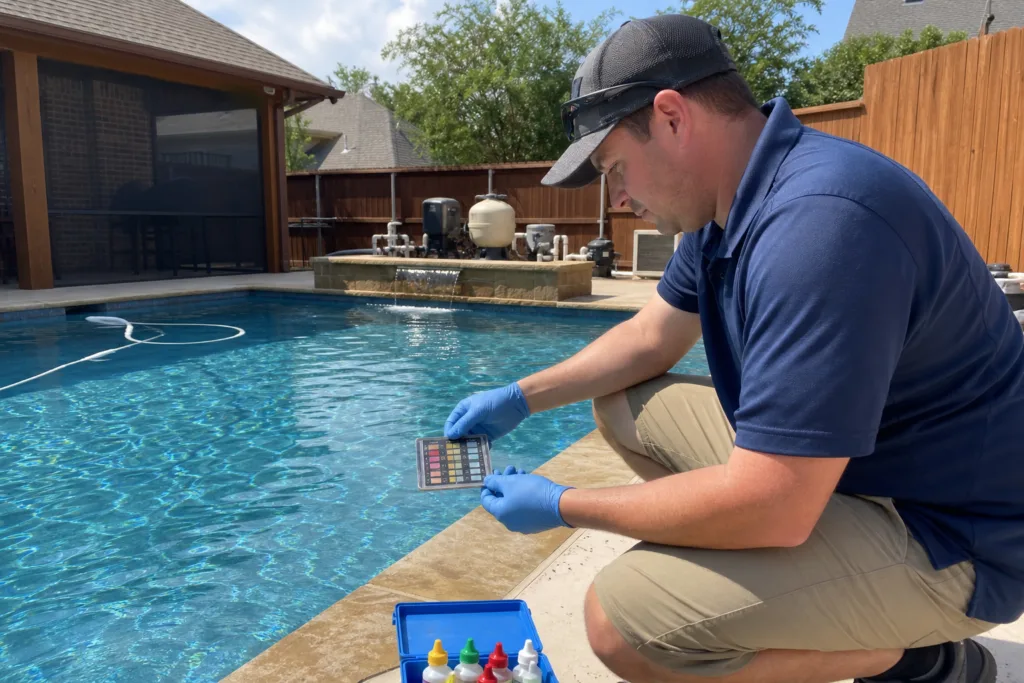
Pool owners across Plano, Allen, Frisco, Richardson, and McKinney share a common challenge: consistently high pH readings after filling or topping off their pools. This isn't a coincidence or a sign of poor maintenance—it's a direct result of the water supplied by the North Texas Municipal Water District (NTMWD). Understanding why this happens and how to manage it will save you time, money, and frustration while keeping your pool swim-ready all season long.
Understanding North Texas Municipal Water District Water Chemistry
The NTMWD serves over 1.9 million people across our region, drawing water from multiple reservoirs including Lake Lavon, Lake Texoma, and the East Fork Water Reuse Project. The water delivered to your home typically has a pH between 8.2 and 9.0—significantly higher than the ideal pool range of 7.2 to 7.6. This elevated pH is intentional and beneficial for drinking water systems because it reduces pipe corrosion and protects municipal infrastructure. However, this same characteristic creates immediate challenges when that water enters your pool. The high pH also comes with elevated total alkalinity, often measuring 150-200 ppm compared to the ideal pool range of 80-120 ppm. When you add NTMWD water to your pool, you're essentially adding a pH and alkalinity booster directly into your water.
How High pH Affects Your Pool
When your pool's pH climbs above 7.8, a cascade of problems begins. Chlorine becomes significantly less effective—at pH 8.0, your chlorine is only about 33% as effective as it would be at pH 7.2. This means you're wasting money on sanitizer that isn't protecting your water properly. High pH also causes calcium scaling on your tile, equipment, and pool surfaces, creating those white, crusty deposits that are difficult to remove. Your water becomes cloudy, and swimmers often experience skin irritation and burning eyes. The water feels different too—swimmers sometimes describe it as 'slippery' or harsh on the skin. For regular pool cleaning and maintenance, high pH makes every chemical adjustment more complicated because alkalinity acts as a buffer that resists pH changes. You can't simply add acid and expect immediate results when your alkalinity is elevated along with your pH.
Why You're Constantly Adding Fill Water in North Texas
Evaporation rates in Plano and surrounding communities are higher than many pool owners expect. During summer months, outdoor pools can lose a quarter to half an inch of water per day through evaporation alone. With temperatures regularly exceeding 95°F from June through September, you might need to add several inches of water each week. A typical residential pool measuring 15' x 30' loses approximately 935 gallons per month just to evaporation. Add in backwashing, splash-out, and filter cleaning, and you're replacing thousands of gallons throughout the season. Every time you add that NTMWD fill water, you're introducing more high-pH, high-alkalinity water into your system. This is why your pH readings climb so quickly even when you've recently balanced your water. It's not that your previous treatment failed—it's that you've diluted your balanced water with unbalanced fill water.
The Right Way to Manage pH After Adding Fill Water
The key to controlling pH isn't fighting each spike individually—it's managing total alkalinity first. Since alkalinity buffers pH changes, you need to lower alkalinity to the 80-100 ppm range before pH adjustments become effective and stable. Use muriatic acid or dry acid (sodium bisulfate) to reduce both alkalinity and pH together. Add the acid to the deep end with the pump running, and distribute it around the perimeter rather than dumping it in one spot. Retest after 4-6 hours of circulation. This process often requires multiple treatments over several days because you're not just adjusting the water—you're gradually replacing the chemical makeup of hundreds or thousands of gallons. Regular pool cleaning services understand this process and can time acid additions appropriately to avoid overcorrection. Once alkalinity is in range, pH becomes much easier to maintain with smaller, less frequent adjustments.
- Test pH and alkalinity within 24 hours of adding significant fill water
- Lower alkalinity first using muriatic acid distributed around the pool perimeter
- Allow 4-6 hours of circulation before retesting
- Add acid in multiple smaller doses rather than one large treatment
- Keep water circulating during treatment and for several hours afterward
Pool Cleaning Schedules That Account for Local Water Quality
Professional weekly pool cleaning in Plano looks different than in areas with neutral fill water. Your service should include pH and alkalinity testing every single visit—not just chlorine checks. During summer months when evaporation and fill water additions are highest, testing twice weekly becomes necessary for many pools. Proper pool maintenance means tracking how much fill water you add between services and adjusting chemical treatments accordingly. If you're adding 500 gallons of fill water mid-week, your pH will be significantly different by your next service visit. This is why trying to maintain perfect chemistry with monthly or bi-weekly service rarely works in our area. The chemistry changes too rapidly. Weekly pool cleaning provides the consistency needed to stay ahead of pH spikes rather than constantly reacting to them. Your service provider should also be monitoring calcium hardness, since our fill water can push calcium levels up over time, increasing scaling risk.
Equipment Impact from High pH Water
Pool equipment repair calls in our area frequently trace back to scaling and mineral buildup caused by consistently high pH. Heat exchangers in pool heaters are particularly vulnerable, as calcium deposits form on heating elements and reduce efficiency before causing complete failure. Salt chlorinator cells develop scale buildup that blocks water flow and prevents proper chlorine generation. Filter cartridges and DE grids cake up faster when pH stays elevated. Even pump seals and gaskets deteriorate more quickly in high-pH conditions. During pool inspections, we regularly find equipment that's 2-3 years old showing wear patterns typically associated with much older systems. This premature aging is preventable with proper pH management. If you're experiencing frequent equipment issues, reviewing your pH history often reveals the underlying cause. Leak detection services also find that high pH water accelerates deterioration of plaster, grout, and concrete surfaces, leading to structural leaks that could have been prevented with better chemistry management.
Seasonal Considerations for Plano Pool Owners
Our extended swimming season—typically April through October—means seven months of high evaporation and frequent fill water additions. Spring pool openings require special attention because NTMWD water chemistry can vary seasonally based on source reservoir mix and treatment processes. Summer demands the most vigilant pH monitoring as evaporation peaks and pool usage increases splash-out. During winterizing, properly balancing pH protects your pool surfaces and equipment during months of limited circulation. Even in winter, you'll need to add fill water occasionally to maintain proper levels, and each addition still impacts chemistry. Pool renovations and equipment installation projects are ideal times to upgrade to automation systems that monitor and adjust pH continuously, taking the guesswork out of managing our local water challenges. Energy efficient pumps with variable speeds give you better control over circulation and filtration, helping maintain consistent chemistry by keeping water properly mixed and filtered.
When to Call for Professional Pool Service
While many pool owners successfully manage basic maintenance themselves, certain situations call for professional help. If you're adding acid weekly but pH remains stubbornly high, your alkalinity likely needs professional attention. When you notice scaling on tiles, equipment, or surfaces, addressing the underlying pH problem requires more than surface cleaning—it requires comprehensive chemistry correction and possibly equipment service. If your chlorine consumption seems excessive but your pool still looks cloudy or develops algae, high pH is probably reducing sanitizer effectiveness. After adding several inches of fill water following heavy rain or equipment repair, professional testing and balancing prevents the chemistry swings that damage equipment and surfaces. New pool owners in Plano often benefit from professional weekly pool cleaning for at least the first season to understand how our local water behaves and learn proper management techniques. Filter cleaning combined with water testing provides a complete picture of how well your filtration and chemistry are working together.
Keep Your Plano Pool Balanced Despite NTMWD Water Challenges
Pool Service Plano understands the specific chemistry challenges that North Texas water creates for local pool owners. Our weekly pool cleaning and maintenance services include comprehensive testing and balancing designed specifically for NTMWD water characteristics. We'll keep your pH in the ideal range, protect your equipment from scaling damage, and ensure your pool stays swim-ready all season. Contact us today for reliable pool service throughout Plano, Allen, Frisco, Richardson, McKinney, and Dallas.
We’re Here To Help
Call or send the form with your service details and location.